Top: St. Paul’s Chapel
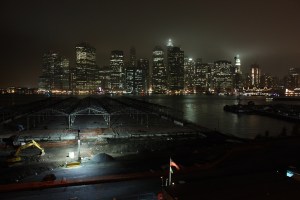
Middle: Greenwich St.
Bottom: Vesey St.
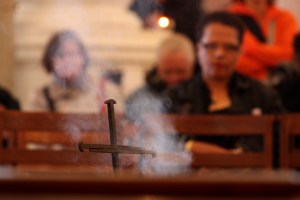


Top: St. Paul’s Chapel
Middle: Greenwich St.
Bottom: Vesey St.
On one hand, we could use the first half of District 9. It’s got ferocious energy and a campy treatment of aliens living more or less peacefully among us, and – to a point – is told with the schlocky enthusiasm of reality TV that somehow feels more legitimate with its racial overtones. Partly this has to do with its look: director Neill Blomkamp and his cinematographer, Trent Opaloch, have enormous fun with the throwaway suggestiveness of a well-placed documentary camera, tagging along as a team of government bureaucrats attempts to evict over a million aliens from their South African internment camp. And partly it’s their unyielding commitment to present the situation with a straight face; Blomkamp deserves some kind of credit for trusting that we don’t need to see him tipping his hand. If they’d stuck to this concept religiously, they might have had a wonderfully pleasurable little parable along the lines of Starship Troopers (1997), and retained the self-contained mystery of why the alien ship has stalled above Johannesburg to begin with, leaving its amusingly docile crew subject to the tactless anxiety of the human race.
On the other hand, it gives me no pleasure to agree with the contradictory likes of Armond White, but in the case of District 9 I think he’s deeply right. Furthermore, whatever your personal feelings about a director’s implied intentions, Blomkamp hasn’t done himself any favors with interviews in which he discusses his disappointing failure to pull off Halo with producer Peter Jackson. I doubt Blomkamp has much interest in the social metaphor lurking within District 9 outside of the extent to which it’s yet another familiar trope to add to this ratatouille – which includes the Hollywood war-realism of Black Hawk Down (2001) mixed with the disturbingly chaotic violence and social/racial undertones of Children of Men (2006), and a weird dash of Aliens (1986) – and this is okay, except that he’s consciously alluding to real, complex issues with the casual flippancy of a college sophomore with scant perspective (it’s no excuse that he’s from South Africa; he’s still making a movie). I don’t know what I’m supposed to make of such a slapdash stew. But Blomkamp’s silly descent into ultraviolent mayhem in the movie’s final third seems to tell me everything he makes of it. I found his infantile insincerity making me angry.
What kind of reaction is that? I guess I’ve just had enough of joyless destruction in movies. If it’s supposed to be fun, make it fun; let the fascist army of Starship Troopers lose their heads – and arms, and legs – in a broadly allegorical campfest, but don’t leave enough room for us to invest a fuller-dimensional social context for the scenario in District 9, and then start annihilating the human quotient in wet splatters of blood and tissue for our amusement.
I fear tackling a review of There Will Be Blood. It’s every bit a function of my own literary limitations, my shortage of vocabulary, and my suspicion that, when presented with an absolute marvel in one medium, encapsulating it in another is near futile. Imagine a film adaptation of A Portrait of the Artist as a Young Man; no acting chops or trickery of light and sound can approximate Joyce’s sumptuous, visually suggestive orchestration of written words. So I am tempted to just declare Paul Thomas Anderson a master of cinema. I am tempted to call his film a virtual catalogue of flawless writing and direction, his craft the steak to his performers’ potatoes. I’m tempted to call Daniel Day-Lewis not only the subtlest, fullest actor in cinema history, but also the consummate collaborator, as there’s no mistaking this as anything but an Anderson film. I am tempted to simply demand that all people see There Will Be Blood and experience my wonder first-hand.
And this would, of course, be fruitless and silly. Blood is a film, no more or less, two hours and forty minutes of flickering celluloid with no more real power to chop down mountains than the feelings of sheer elation that compel me to write. Yet I remember the feeling of seeing it for the first time, at the Brooklyn Academy of Music in January 2008: the unalloyed joy of a film wholly executed. Not scrapped together from spare parts, or joined at the seams with putty for the sake of a bigger picture that, seen from afar, looks pretty good. There is something spit-and-polished about the thing from a distance, appearing lumpy and askew, dangerously hewn to a performance above clarity or depth. But Blood holds up best under acute scrutiny, in the same manner as a Joyce novel: utterly crafted with the singular tools of its author, with a purpose and focus that reveals itself fully only at length.
It’s impossible to say whether Anderson considers craft or narrative more crucial to his filmmaking at this point. I venture to argue that with most filmmakers, it’s going to be one or the other. There’s a Spielberg on the one hand, who’s honed his own eccentric style ad absurdum. No story ever takes as much formal precedence, or sways Spielberg far from his dazzling kineticism (Schindler’s List (1993) alone stands up for debate, but opens other questions of craft versus manipulation). There are the untold numbers of styleless hacks who’ve forgotten the term motion picture. And then there are the few in between, but among contemporary American filmmakers I can think of a small number – Scorsese and Coppola in their respective primes, Altman as his finest – for whom there is no discernible distinction between form and meaning, and Anderson, years ago with Magnolia (1999) and Punch-Drunk Love (2002), joined their ranks. Those films saw projected light for what it can be: a palette for sketching, vibrantly, a few of the countless mysteries of being alive.
There Will Be Blood is the most fully realized film of his career. It is a film about fathers and sons, and greed. It is about inflammatory bile that has festered below the surface, waiting to explode. It’s about the ugly commingling of the hypocrisies of blood-oil and religion that might be used to define American culture even today. Anderson’s Daniel Plainview (the name is so obviously descriptive as to be beyond symbolism; Plainview might have named himself) is substantially more than hell-bent on plundering. He’s out to succeed above everyone around him, if at all possible at the cost of their faith – in him, or, more accurately, in his total, annihilating success. Plainview is a demon, sick of the stink of human failure but determined to mire himself in it if that will keep his head above its putrid inconsequence. “I see the worst in people. I don’t need to look past seeing them to get all I need. I’ve built my hatreds up over the years, little by little.”
He adopts the orphan son of a worker killed in a well shaft, for reasons that Anderson suggests very quickly in a long take that pushes in on the two of them during Plainview’s first speech to a crowd of townspeople who’ve just discovered a vein of oil. Plainview puts on one goddamn hell of a well-greased show (and can appreciate those of his competitors), explaining in his oddly syrupy, dust-choked voice why he’s the only oilman for the job. But he’s quick to abandon a squabbling crowd – and their oil as well – preferring to cajole man-to-man, or whenever appropriate, family-to-family. He is a salesman, with unconditional love only for his product. Until the last third of the film, though, Plainview shows hints of the last strains of human warmth left in him, toward two children and a man who appears one day on his doorstep; a baptism scene, appeasingly undertaken for the purpose of completing his pipeline to the Pacific, reveals the stunning depth of Plainview’s self-hatred: the Godfatherish purgatory for conflating family and business. And there is a final-act flashback of heartbreaking unselfconsciousness, where for the briefest of moments Plainview was capable of real affection toward his ‘son’ before, likely embarrassed, he drifts off again toward his isolated derrick on the scrubby plain.
There’s a catalyst for his disintegration: the son of a local farmer, and the apparent twin brother of the young man, Paul, who led him to the town of Little Boston. Eli Sunday is a preacher of fire-and-brimstone damnation who entirely undermines Plainview’s shifty negotiations for buying the Sunday ranch. Is Eli really Paul, screwing with Plainview to cash in his family’s property to build his church (or is he just Eli doing it)? As the well goes into the ground and begins to produce oil, the two men vie for the faith, trust, and capital of Little Boston, and for the entrapment and destruction of each other’s souls: Plainview with his wells, “blowing gold all over the place”, and Eli with his church (Eli: “You will never be saved if you…” Congregation: “Reject the blood!”). Eli and Plainview’s evershifting power struggle takes on a subtle, complex momentum, propelling the film toward a beautifully surreal ending, both men reduced to their moldy basest in a bowling alley. Not from lack of habit does Anderson allow a carnival atmosphere to creep, shrieking with delight, over his final sequence, a lunatic creature ecstatic at its inevitable release. It is a magnificent thing to anticipate on a second viewing.
If this much were all the film had to offer, a pleasurably intricate script played cleverly by gifted actors, there could be little chance of blowing the whole thing. But Anderson is also a consummate maker of cinema, as energetic as Tarantino but more patient; as articulate in his craft as latter-day Scorsese but with no softening urge to please. A landscape is not simply a vista for Anderson. It’s an expressive canvas, and he puts his camera immediately to work in the opening shot, framing three massive hills against a baking midday sky, followed by a younger Plainview biting with a pickaxe at the wall of a mineshaft. The first fifteen minutes of the film contain not a word of discernible dialogue, but by the end we’ve seen an entire backstory and have a firm sense of the way Plainview approaches the world (with an axe and alcohol, stubbornly). Later, whole scenes play out in wide shots on the plain, with characters roving in and out of view, forward and backward in space, critters with agendas toiling over an indifferent earth.
What Anderson does not try to do, graciously, is mimic or approximate Plainview’s psychology with his camera. For all the shots of the man on an empty landscape, I’d argue that to just call Plainview isolated would be to trivialize Day-Lewis’ complex performance. If Plainview is a lonely man, he’s lonely by choice and intent, and both actor and director are too intellectually active to summarize the character in cheap visual metaphors. We’re meant to understand Plainview as the master of his own destiny – inasmuch as any man can be – skulking across creation in his outsized hands and feet, a crab-monster with a dangerous capacity for burying other men facefirst in the mud. He’s also an observant man, who watches and plans his next move as an erupting oil well sets fire to a towering derrick (while the son lies badly wounded in the opposite direction). In the middle of this sequence, Anderson provides a startling shot: the burning pyre of a derrick, small in the middle of a vast black prairie, the dusky sunset on the horizon. It’s an island of human destruction-achievement, a tiny hole in the world torn open by measured greed. These moments hover over us from Anderson’s perch as the executor of his own peculiar universe, and I find it encouraging to see a filmmaker acknowledging his authority as a sculptor of sound and light, rejecting the idea that his invisibility somehow best articulates a story’s purpose. We might otherwise not have such ebullient, self-contained master classes like Last Tango in Paris (1972) or Raging Bull (1980) – or, for that matter, Citizen Kane (1941) or The General (1926).
Oh, yes. As with so many others, above that scene – competing with it for the bolder declaration of metastasizing chaos – is Jonny Greenwood’s thumping, roiling score. A post sound mixer friend of mine finds Greenwood’s music intrusive, mixed as it is very high in the soundtrack. It frequently overtakes the natural sound in a scene, sometimes even the dialogue, with its slippery, discordant strings or its aggressive percussion. Taken as a tool of the craft, I don’t see why Anderson can’t use it with pointed affect rather than as subliminal tone (it does both). It has a life of its lively own, as much a part of Blood‘s complexion as the people who occupy the film, or the pensive dance of light and motion that characterizes Robert Elswit’s camerawork. It’s got a tendony quality, like most scores, holding together and helping to flex the muscles of separate scenes, but I can only imagine the pure joy Anderson must have taken ladling it over his film, several years in the making, an au poivre over Day-Lewis’ medium-rare performance.
A measure of my ability to wrestle with art at all, it’s taken me the better part of two years to be able to articulate my understanding of this film. And coming to the end of a review so rambling and lopsided, I’m reminded of the many alarming times I’ve worried that There Will Be Blood might ultimately be a hollow, flamboyant exercise. It takes giant chances with its circuitous storytelling, risking coherence for consistency of tone and style. The story itself offers no redemption of any kind. It’s left many of my friends feeling drained and confused; a few have suggested that, without Day-Lewis’ hypnotizing presence, Blood would be boring. They may be right, but that’s like saying that without wings a plane may not fly. It also wouldn’t be a plane. More to the point, a work of art constantly risks subjective failure. Real communication through a medium as intuitive as film is profoundly personal, operating more on the rhythms between concrete action than on the mechanics of narration alone. To read a Joyce novel is surely to receive a story at one level, but the degree of a reader’s receptivity to literature as artful tides of suggestive language, ebbing and flowing with the command of the writer, determines the depth and quality of the reader’s experience. I say the same holds true of There Will Be Blood, with cinema in place of literature. I can’t prove it objectively, but I can try to relay the ways in which it’s arrested my intellect and engaged my emotional faculties, developed as they are from my own experiences. With a bit of cinema, and a bit of life.
We first met this man for an hour one day before lunch, at his office in Kabul. He is a slight diversion in our film about photographer Reza, but they are old friends from their years with Massoud. Despite prior communication with his staff, it took the better part of an earlier hour to get inside, so we sat on the curb and waited, the bustling late morning traffic at curious shrugworthy odds with the lackadaisical pedestrians hunched nearby. Dr. Abdullah’s armed guards patrolled the front gate, a nondescript alleyway between a fitness shop and, well, some other shop, as forgettable as those of any city block.
The thing about security in Kabul is that, when told not to film in one direction or another, you must simply wait until no one’s around to say no – or, just as good, until you’ve made friends with the people who’ve told you no. One end of the street bordered an administrative building of some kind, heralded by a red-and-white enclosure , so, with Reza wired for sound, we filmed his impromptu conversation with the lemon vendor parked in the opposite direction to kill time. Soldiers armed with Kalashnikovs – a sight so common throughout Afghanistan that their relative absence in provincial villages began to parody their abundance elsewhere – patrolled a razor-wired gate across the street, beyond a cart loaded with watermelons whose caretaker dozed in the dry heat. We snuck off shots of the soldiers, between cars, when we guessed they weren’t looking.
 Between mixing Reza’s lavalier, I took pictures of the watermelon vendor, the men passing time on the sidewalks, a pair of bicycles chained to a tree. And then suddenly we were beckoned in, granted permission by a cadre of invisible higher powers working immediately below Dr. Abdullah – the Lion of Panjshir Ahmed Shah Massoud’s ally and chief political advisor during the Soviet war; former Deputy Minister of Foreign Affairs for the Northern Alliance during the war against the Taliban, reappointed during the interim administration in December 2001, and confirmed the next year to serve under the Transitional Islamic State of Afghanistan; a trained opthalmologist; and candidate for the presidency of Afghanistan, having formally registered the day we arrived in Kabul on May 6, 2009.
His gate patrol was friendly and polite, no doubt treating us as friends of Reza instead of Americans or media; they glanced at my shotgun mic and searched my mixer bag as a matter of course – the airport guards would ransack my bags two weeks later as I was on my way out of the country as though I were smuggling their burka-clad women. Behind the gate sat a small office building with a front desk and a single hallway branching off into the various meeting rooms, where quiet bearded men sat in comfortable chairs around glass tables laden with dishes of dried fruit and sugar-coated almonds. Hallways are our lobbies; whatever takes place behind the frequently open doors is never far away, and the pertinent door is never entirely clear.
I had a picture of Dr. Abdullah before we arrived. I knew little about him, except that we was a medical doctor and a confidante of Massoud’s. I imagined him as an older man, looking serene and wise in a robe and long beard, well-trimmed as befitting a politician but humbler in dress, as befits a freedom fighter. Dr. Abdullah is full-on politician. He dresses – in Kabul – in fine suits, wearing a short beard and groomed gray hair. He is average height and carries a middle-aged belly, and a face that, on the stage of geopolitics to which he aspires, is entirely unnoteworthy. It did occur to me then that there should be no practical reason why Massoud’s most trusted associates should have distinguished features, but given Massoud’s own striking face and unmistakable scarecrow physicality, I envisioned a Dr. Abdullah who would first and foremost impress in appearance alone. He does not.
What does strangely impress is his quiet way of speaking, his immediacy of presence. We filmed his initial greeting with Reza before meeting him ourselves, and there is no doubt that as a politician – as a meeter of people, as a social entity, as a potential leader – he wields considerable gravitas. But as is often the case with politicians, you’re simply not aware of it until afterward, when upon reflection his stature begins to stack up against the people around him. With Reza, he is familiar, even intimate. They speak closely and softly from four or five feet away in opposing chairs, both conscious of our cameras and completely complicit in each other’s faint posturing. They are men of self-aware prestige, and have finessed the art of pose. It’s not unnatural, really, nor false, not among equals. They both know their weight in their relative fields, and care, passionately, that they do not appear insincere.
Their conversation is slight, somewhat rigid. They have not met in some time, and their personal ease mixes awkwardly with their need to say something important for our camera. Even as a sound guy, there are times when I’m more absorbed by a person’s behavior and the environment than by his words; Reza and Dr. Abdullah speak skirtingly of the need for proper leadership in Afghanistan, its brittle future, its chunky past, but I examine the open laptop in front of the fireplace; the tight organization of the couches and chairs in the room and our cameramen’s attempts to manuever them; the carefully framed position of Reza’s and Dr. Abdullah’s chairs, so clearly arranged for two conversing men to be photographed. The windows just behind them are tightly curtained, so the room is oddly dark, illuminated only by the sunlight coming in from the glass doors across the room that somehow fails to bounce off the yellow walls. Dr. Abdullah’s men stand silently in the front of the room near the door, a handful of suits without personalities. The job of a politician’s henchman can’t be a glorious one, especially when your man is so obviously risking his life to run for the presidency, and these guys took it with a humbling seriousness. When the meeting was over, they shuffled us out of the room with little more than the usual pomp, reserved mostly for Reza, and we were out of the building in a minute or two.
The next day we were on our way out of Kabul for the Panjshir Valley, and within the week met Dr. Adbullah twice in the valley. As a Northern Alliance mujahideen, he would be greeted in Panjshir a virtual hero. Ostensibly he was there to run for president, but his office and our crew were in irregular communication along the way, and the possibility of appearing in a National Geographic documentary couldn’t hurt him. We ran into him – or rather, his convey overran ours – on the rutty, unpaved road heading north through the valley. His SUVs passed ours and stopped in the village ahead of us as Reza tried to hurry our driver to catch up. The doors on his vehicles opened with military precision and his armed guards flanked the road ahead and behind the convoy, ignoring us as we pulled to a stop just behind the last SUV. Their AK-47s felt excessive here, among their strongest supporters in the entire country; that Dr. Abdullah did not appear, and his convoy suddenly packed in and raced ahead before Reza could get his attention, seemed indicative of the show of effortless force a presidential candidate probably feels he has to exhibit to convince the Afghan populace he’s worth voting for.
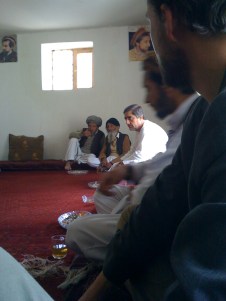 Our vehicles caught up with Dr. Abdullah’s a few miles up the valley, in a tiny village. The local elders were all there, and Abdullah was dressed in a traditional white kurta instead of a suit. We joined them in the second story of the only building in sight, in a room barely long enough, we would discover that night, for four men to sleep head-to-foot, as a giant meal – entirely out of scale with our rural environs – appeared on the floor before us. A small, wizened man at the head of the room dominated the conversation by status and reputation alone, it would seem, as he uttered only a few words among the roomwide banter but drew rapt attention for each of them. He commanded substantial respect from both Dr. Abdullah and Reza, and the hierarchical configuration of tribal Afghan society was never clearer to me than it was during this lunch. The tone among leaders is one of lighthearted mutual respect, reminiscing on old times with a ponderous, vaguely self-conscious solemnity that, from time to time, can veer into emotional displays embarrassing for those of us without the cultural background to grasp its purpose. The past is something to acknowledge and revere with feeling. Our foreign selves excluded, every man in this room shared viscerally in that past.
Dinner wound to a close, and before Dr. Abdullah left, he and Reza repeated their conversation in Kabul, but this time with patience and greater openness, discussing the current trajectory of Afghanistan and Afghans as it seemed to them rather than as it played well for a camera crew. They sat side by side on pillows in front of the window and spoke in low, intimate tones, so low that at times I had opened up their microphone channels all the way on my mixer, magnifying every foot shift and murmur from the other men in the room. Dr. Abdullah speaks as a gunless general leading troops to bloodless battle, calm in his self-assurance and confident of his mission, and Reza listens as an old friend, trading Abdullah’s candor for unqualified support for his candidacy. They strike me now as a pair of veterans, corraling their vast experience and complicated knowledge toward a sincere plan for the country’s future. They understand Afghans’ fierce national pride and their collective shortcomings, and Dr. Abdullah voices more than once the inherent personal danger in running for Afghanistan’s presidency, of the almost certain voter fraud and, let’s say, extranational coersion that he feels will surely put Hamid Karzai back in office on August 20.
* * * * *
We ran into Dr. Abdullah once more, outside a mosque in Panjshir where he and his retinue had stopped for noon prayer. He emerged from the mosque into the gathering supportive crowd, shadowed by his Kalashnikoved guards and hounded by our enormous camera, appearing at ease and in his element. Our trip ended on May 21, and he has continued his abbreviated run for president since. He holds second in the polls only to Karzai, who’s reviled in Afghanistan as a feckless Western appointee but who may win, perhaps on those very grounds. Abdullah has traversed the country, addressing crowds in places, like Kandahar, where many of his opponents are afraid to appear; on July 28 gunmen wounded one of his campaign managers in western Afghanistan in an attack that killed the car’s driver.
Even if he wins the election, Abdullah would face the Taliban in the west and south of the country, growing insurgency against the American occupation throughout the country, and a pervasive cultural attitude that does not yet grasp the dynamics of democracy as we understand it. He will be expected, like Obama, to fix the frustrating failures of the last administration with inordinate speed, and to bring peace to a country at current war with its former conqueror and on the verge of a second war with a current ally.
He seems to know he will lose to Karzai; his late arrival to the race suggests a near half-heartedness to his candidacy, but then, there is something unpredictable about the country’s mood anyway. Afghanistan is pie-sliced from top to bottom: broken in the east, on fire in the south, and barely healing in the north, in terrible need of a unified direction thus far eluding its factions, tribes, and national politicians. Yet Abdullah runs, with a heedless, unreasonably bold assurance Afghans should recognize. The approach may or may not put Afghanistan back on a progressive, self-sustaining track, but for the last 30 years, nothing else has.
Bare minimum, Kathryn Bigelow’s The Hurt Locker finally moves contemporary war films beyond Ridley Scott’s Black Hawk Down (2001) – which for years, to my mind, appeared to have accomplished the most experiential perspective on modern warfare that Hollywood has the patience to display. But war feels distinctly immune to rhapsodizing; whenever characters are required to spill their emotional guts in polished monologues about how ‘it’s about the man beside you’, or ‘I just can’t take it anymore, man’, something ineffable slips away. I no longer feel the dirt and fear that must, must reside alongside armed combat. I just feel screenwriting. Black Hawk Down suffers from far too much of this, and Scott is a lazy director (he can’t shoot to edit, and he’s prone to excessive music) but he does sustain two solid hours of wearying, soul-eroding strain.
That’s the easiest level on which Bigelow’s film works well. Building scenes with extraordinary tension seems second nature to her here, and she does it mostly with carefully modulated performances, as well as playing off our expectations. Shots that seem to suggest impending onslaught lead nowhere; innocuous chitchat on the periphery of battle doesn’t necessarily foreshadow imminent attack. People chatter under pressure, and distant phones do ring, and helicopters will fly overhead without effect. A civilian watching from a balcony, filming with a videocamera, might be as curious about the outcome as the soldiers who have just spotted him through their weapons’ sights. It seems silly to commend a director for not slathering music all over her film, but Bigelow is judicious with her score – it offers occasional mood, little more. Moreover, she recognizes the effect of technical flukes, and moves beyond the standard shaky camerawork and jumpy editing to letting us hear mic rustle and the muffled canned quality of an unmastered lavalier, buried in clothing somewhere around an actor’s throat. I felt I was inside a film in the sweaty, claustrophobic process of creating itself.
Having twice in my life been far too close to gunshots fired in anger at live human beings, by people who would consider themselves combatants, I can say with certainty that the experience offers no insight beyond its own foolish inadequacy as human behavior. Men don’t charge courageously into the maw of live fire; they run or hide from it, because it’s fucking awful. I can only imagine warfare carries a crushing moral load, and incites greater indignation, as a sustained conflict between men committed to killing each other, and Bigelow seems to agree. Her team of three bomb disarmament specialists works in constant, multidirectional alertness, often disarming a car bomb and keeping track of the men watching them from the rooftops nearby, any of whom could be carrying an automatic weapon or merely a cell phone with which to remotely detonate. But when offered the decision to kill – as opposed to a reaction to return fire – all of these men hesitate, looking for an alternative, hoping for a mistaken intention or an optical illusion in the blazing desert heat. It’s possible Bigelow milks these moments for more than they’re worth, straining behavior for drama, but at least two of these scenes present enormous moral choice, rooted in oppressive physical environment and/or disorienting cultural miscommunication, between people who would rather not partake of death but aren’t sure how to proceed. Threats seem to get the ball rolling.
I could be losing my patience with feature-length films in general, but I would almost have been happy if The Hurt Locker was only as long as its opening sequence, masterfully built of continuous subjective discovery and some profoundly impressive acting by Guy Pearce in particular. Yes, it paves the way for the story (which revolves around Pearce’s replacement, played by Jeremy Renner, in what is easily the film’s most conventional element), and also for another aspect of The Hurt Locker that struck me as sort of wonderful. Several known character actors play bit parts – almost throwaway roles, destined in other films for supporting-role performers only, but they don’t feel like gimmicks so much as counterweights to the film’s otherwise appropriately even-keeled casting. Nothing detracts from performance quite so much as an actor’s persona, and in filling the film with recognizable but persona-less actors, she directs our attention toward what they do, not whether they survive. And then she gives us faces we can name, who are no more impervious to war. Bigelow is a fine director of actors rather than stars.
What she’s not is a master sculptor, ultimately. The film has long, fluid sequences – the extended, static shootout in the desert, for example – that play well because of their duration, but I suspect Bigelow thinks too highly of Mark Boal’s script and her actors’ fine work to cut too harshly into their playtime. Certain other sequences – the hypermasculine drunken bareknuckle fistfight in the barracks loses momentum quickly, and acquires no residual dimension – carry on for no particular reason, and I’m of two minds about this. On one hand, my guess is that this is probably closer to the way warfare works: in fits and starts, and long, long periods of interrupted unease that gradually dissolve a person’s mental defenses. But on the other, I’m not sure such dissolution is Bigelow’s point. I think she just loves this material, and badly wants it to stretch beyond the limitations of less ambitious storytelling, of less chunky content. I’m inclined to side with her, if only to resist the destructive tendencies of producers who fear extended running times…but then again, that opening scene might have been enough for me.
I realize, as I approach the end of this review, that I really ought to have savaged this film more, on principal. It’s vulgar cinema, stymied by directionless writing and conventionally chaotic editing, and tries far too hard, in the end, to pinpoint its obvious message. In spite of many of the reviews, it is not an artistic masterpiece. But there is a scene in a bomb-making warehouse, involving the body of a young boy and the stitches holding his stomach closed, that illustrates just how committed Bigelow is to this film, as an experience for us and an apparent obsession of hers. Her command of this film is as assured and relentless as Renner’s bomb specialist, as committed as Ralph Fiennes in his tiny cameo, as professionally illuminating as her cinematographer Barry Ackroyd’s range (he shot The Wind that Shakes the Barley (2006) on steady long lenses, in perfect control of lush color). All of which, eventually, is what The Hurt Locker is about.
Airfield Films is casting ‘Plastic”, a thirty-minute film about the aftermath of a mature relationship between a teacher and a pilot that haunts them both, literally and lyrically. Andrew Baker writes/directs, Matthew Griffin produces, and Rob Featherstone shoots. Rehearsals will be started as soon as possible, and the film will be shot on super 16mm over the course of several months, one or two days at a time, for roughly six days total. Filming locations TBD, in New York City and environs.
Seeking ROB, 30s.
Please submit an email with a headshot and resume, and one or two lines about yourself, to airfieldfilms*at*gmail.com. Auditions to be held in NYC on Saturday, July 24th by appointment. If you are not available that day, please note this in your email. Non-SAG, but some pay.
With its literal facade, film is a pristine quantifier of certain realities, as well as a clunky forum for exploring intangible things like memory and the soul. What it shows is at some level unassailable, and denies interpretation: a chair is a chair, a tree a tree, and for the most part – particularly in motion pictures – action is certain. Its great virtue is showing things happening: Eadweard Muybridge’s galluping horse, the Lumieres’ Arrival of a Train at a Station (1895), the overwhelming impetus of modern cinema as a whole. What it is not good at, from a mechanical standpoint, is casting light on how experience shapes us. What makes us who we are as individuals. Most films, then, provide backstory that gives a character personal purpose, a reason for strong action, and a clear goal, as a bullheaded (but efficient) solution to the alternative: that watching action as we actually live it would offer terrifyingly little closure or purpose for our wayward lives. In this way, understanding a film need not strain the bounds of basic observation.
Up til now, the closest I’ve ever seen a film come to representing memory as a transient vapor would be Wong Kar-Wai’s 2046 (2004): jagged, full of color and shape but such fleeting detail. Fluid and impressionist, Wong captures time and experience out of the corner of his eye, as roaches darting across the kitchen counter: a few he catches and squashes, but most get away under the toaster, half-seen in a glance. Richard Linklater tries something similar in Waking Life (2001), this time building an entire film out of floating, animated gestures, little snatches of scenes befitting his main character’s dreamy semi-consciousness. But it’s the animation that sets the film alight: elusive pseudo-shapes, defined by color and form instead of detail, and entirely free to wobble and distort at will. Both films abolish the illusion of observed reality that film so easily conjures, and the next logical progression would seem to be Ari Folman’s Waltz with Bashir.
I’ve heard that Folman has never worked with animation before this film, and if it’s true, it’s my opinion that he’s found a wildly effective style that lifelong animators should envy. Formally, his animation is not overwhelming or advanced, mostly three or four layers composited into largely static frames. And after a spellbinding opening sequence featuring a pack of dogs tearing through city streets, Folman settles on talking heads for a while. But slowly his method shows itself. Even in these chatty scenes, specific moody details appear: rain, cigarette smoke, breath in a snowy field. Eyes peer. Folman builds these scenes out of natural, subtle behavior, as his characters (a filmmaker, ostensibly Folman, and his various wartime buddies) do shots in a bar, smoke, pause in speech to collect their memories, observe each other. The details are critical for setting up what follows, and what makes Waltz with Bashir an enormously powerful emotional experience.
When Folman slips into the half-formed memories of the Israeli-Palestinian war, screen time passes much slower than dream time; attention darts from one exploding tank to another, and bullets drop bodies with messy, indistinct bursts of gore. A sniper shoots a tank commander through the throat; the man standing beside him can’t understand why he’s slumped over and not moving even as both of them are sprayed with his blood. Spatial confusion sets in; a boy fires an RPG through a sun-dappled forest. The soldiers acknowledge that it is a boy, and destroy him with gunfire. Another soldier finds himself the sole survivor of an ambush, and he swims to safety in the calm, dark Mediterranean, under cover of night and the soul-wrenching isolation that accompanies him. Bashir acquires a meditative dreaminess on par with its clearest ancestor, Apocalypse Now (1979). As the story’s filmmaker struggles to recollect curiously absent memories from the war, a fragmented, druggy flow comes over the film, and for a time all narrative pretense drifts away as we march, huddle, and float with these characters in their own ill-focused, impressionistic memories. Which are all too often not their own, or vary from one another’s.
To be sure, Folman is animating things happening, but he adds a further layer that confounds a simplistic interpretation of observation: that we are most definitely watching a film. Acknowledging a film’s filmness from within has the capacity to uproot a motion picture from a place of storytelling and replant it in the realm of highest art, bestowing a greater sense of purpose on film as a unique art form. It speaks to us with strengths – and weaknesses – as nothing else can, and Folman asks us to consider that a film is neither reality nor truth, but rather a depiction of moving image, full of its maker’s opinions and elipses, and utterly crafted toward a broader design.
Folman’s protagonist, a filmmaker, has somehow blocked out his memories of war, and spends the film in discussion with his old friends. Their stories are to us what they are to him: vague illustrations replete with impressions of emotional memory: tracers zipping through fields; haunted, empty streets; a row of men executed by machine gun against a wall. But then there is a reporter, whom the soldiers witness walking calmly through gunfire as his cameraman crouches in terror. The reporter has no fear, completely insulated from danger by his camera. A psychiatrist offers the filmmaker the story of a soldier who brought his camera with him during the war, and only began to feel fear after his camera broke. And masterfully, Folman includes a small touch criticizing the truth in the act of filming, when one of the protagonist’s buddies gives him permission to illustrate his child at play – but with drawings, not a camera.
One final gracenote in Bashir arrives at the very end, and coming as it does after such loving attention to the way our dreams and memories reveal themselves to us, it is startling, profoundly disturbing, and beautifully justified, giving absolution to the suffering and reflection of Folman’s characters. War films are incredibly hard, it seems, to make anew, as Hollywood fetishizes dismemberment and softer films focus on conventional character development, with war as backstory. Folman sifts Waltz with Bashir down to our tangible disturbance in failing to grasp what lingers in our subconscious – and eventually, I believe, in the closing shots, to what’s necessarily destroyed should we ever grasp it: the reason for making art at all.



Beautifully put, Bill.
Posted in Commentary on September 11, 2009 by bakerI urge anyone with a moral conscience to listen to Bill O’Reilly from time to time. He appears to believe so fully in his self-proclaimed nonpartisan objectivity that, on the topic of, say, Obamacare, he helps to shed light on the elusive (and vaguely contradictory) perspective of the catchphrasing conservatives. No one so deaf to hypocrisy could fail, eventually, to reveal their underlying concerns.
On last night’s Talking Points, he says this about the immediate ramifications of Obamacare:
“They key here is quality control. The President believes the Feds can impose a more efficient system and hold private insurance companies accountable for misbehavior. Which is unfortunately rampant, as you may know, if you’ve had to spar with the insurance people to get reimbursement – I have. Talking Points believes strict oversight is possible, but tough guys would have to be hired, and that would mean a large expansion of the federal bureaucracy, something conservative Americans loathe. The strength of Obama’s vision is controlling costs and eliminating the chaos that comes from forty million uninsured Americans potentially using hospital emergency rooms for medical care. The weakness in Obamacare is the massive spending involved, and the specter of rationing health care. Because there will not be enough doctors to handle all the patients, so we’re gonna have to wait. At this point the President is basically dodging those two realities.”
Leave a comment »