Friday, December 11, 2009.

Sunday, November 22, 2009. Park Slope.


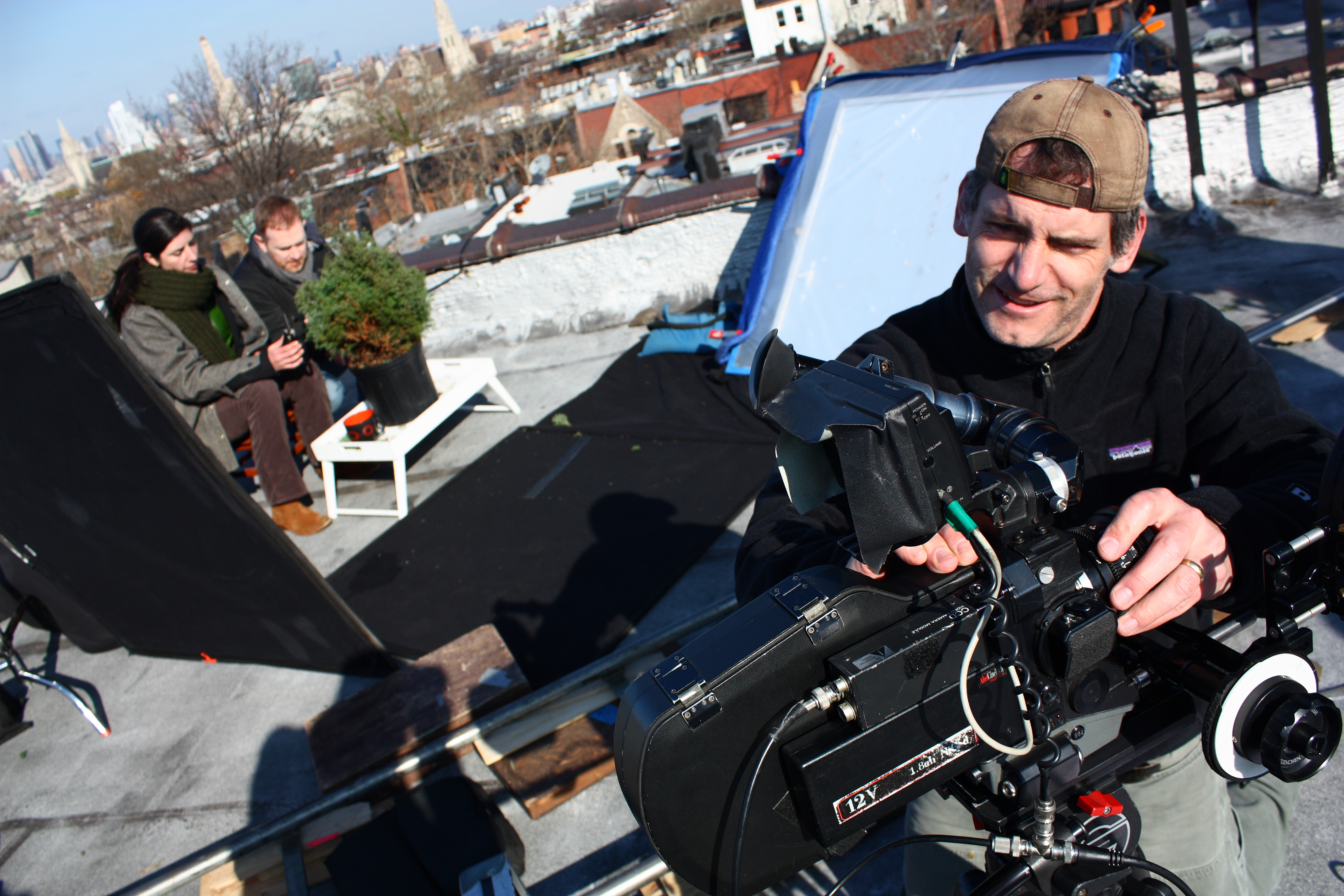

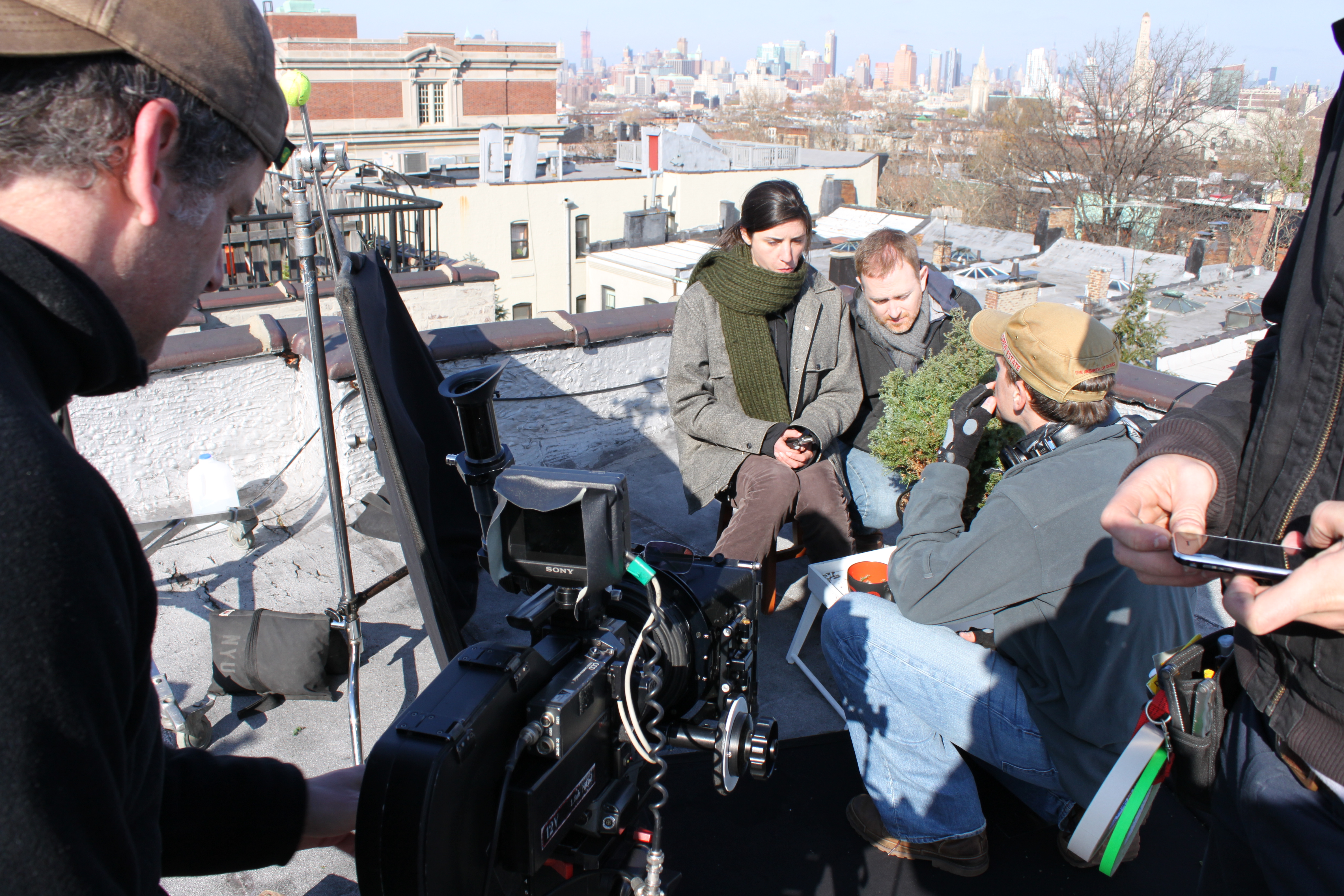


thumbs up to mixer Tim Bartlett and magician/producer Matt Griffin for additional photos.
As a filmmaker, Herzog often doesn’t appear to give one good goddamn about his stories. He slaps them up on the screen so he can plunder them, of unique performances and unearthly beats, in ways no other filmmaker ever born could dream up (or at least dare to tackle). Fitzcarraldo contains an extended sequence of scurrying masses of indigenous Amazonians hauling an enormous riverboat over the narrow berm of land separating two strands of the same river – and it’s no mystery now, as if the film doesn’t illustrate it clearly enough, that Herzog actually accomplished this. No CGI in 1982 could do what Herzog did with hundreds of extras and a lot of leverage, and this bizarrely awesome chunk of filmmaking stands straight up from the somewhat mediocre drama around it, a colossus of imagination and cinematic integrity. Everything else is an excuse to give us such moments of thundering visceral effect.
No shock, and in typical Herzog style, that Bad Lieutenant contains two scenes of such startling conceptual brilliance that the rest of the film feels sort of shapeless, but in a way that seems to give rise to the best parts. The first involves Nicolas Cage’s drugged detective and a pair of iguanas perched on a desktop, and the tiny handheld camera used to film the sequence. It’s an odd effect for Herzog, absolutely attuned to the psychology of his main character but perversely tiny in scale, and the comic genius of the scene only grows with its ridiculous duration and the flawless timing of performance and editing that concludes it. The second involves thugs, guns, and Nicolas Cage’s drugged detective giving perhaps the best excuse in film history for shooting a dead man again: “because his soul is still dancing”. What follows is a staggering few seconds’ cartoon of psychological malaise so vibrantly timed and rendered that, for the few brief seconds, Bad Lieutenant soars. We’re in another film.
Ultimately Herzog doesn’t quite know how to build to and from these scenes; they just emerge, free-floating, from the film’s ambient fog. Which is pleasurable enough, more Touch of Evil (1958) than Abel Ferrera’s Bad Lieutenant (1992), filled with blasts of colorful light and careening wide-angle photography and Cage’s untethered performance. But all this doesn’t feel intrinsic to anything contained in the film, or inducive of anything beyond. Bad Lieutenant feels like a rough cut of a much better film, its strongest elements in place but the connective tissue half-formed – a little premie, crying with life but unprepared to fend for itself (the ungainly, weirdly pirated title does little to compensate). It’s not a new problem for Herzog. Cobra Verde (1987), Woyzeck (1979), Even Dwarfs Started Small (1970) – these are all missing parts, trundling along on vim and enthusiasm instead of cohesive cinematic fluency.
The same could be said of Cage’s performance. Just prior to Bad Lieutenant‘s release in New York, the Times ran an article by Manohla Dargis exploring Cage’s wayward choices as an actor (“Madness or Method? Tough to Tell“). She’s right to emphasize his broader strokes, like Con Air (1997) and Peggy Sue Got Married (1986), yet she skims over Leaving Las Vegas (1995) without moving on at all to what, to my mind, is Cage’s best work to date: Scorsese’s Bringing Out the Dead (1999). Cage can ham it up with bravado in The Rock (1996), but he is also capable of extraordinary pathos under the guidance of an intelligent and discerning director. His Frank Pierce is a moody wisp of a man wallowing in his own guilt and inconsequence – I can’t imagine another actor in the part. Scorsese convulses his way through Bringing Out the Dead to the tempo of Van Morrison’s “TB Sheets”, heaving and lurching through three nights with a paramedic battling the specter of death on a few hours of sleep. The film is a violent plane ride, the kind that has you worried about the airframe, and Cage is the kind of actor who will risk thespian virtuosity for the sake of turbulence. He’s got the face for it, soft but full of shadows, and when he opens his toothy mouth, the whole thing changes shape. Perhaps no one else short of Daniel Day-Lewis could consciously lift his gangling arms above a throng of giggling schoolgirls to avoid tarnishing them with his grimy soul.
Knowing that Cage is capable of so much tact, it’s concerning to see him repeat himself in Bad Lieutenant. The performance is a best-of amalgamation. I don’t deny that Herzog needed Cage’s abandon; Cage is a star, and Klaus Kinski is dead. But I wonder if Cage has played himself out, whether he’s got any new facets to show. The other possibility is that he needs the formal rigor of a Scorsese, rather than the free-form vigor of a Herzog, to find the right balance between honest expression and grandeur. Under Herzog, he leans too far to the latter, for effect instead of connection. Then again, so does Herzog – it’s hardly a surprise to learn that he completed two films in 2009. The other, My Son, My Son, What Have Ye Done, is due for release in December.
Maybe bounding from odd peak to obscure hill is Herzog’s unique place, in world cinema, to keep. For all of his complete fiction films – Aguirre, the Wrath of God (1972), Nosferatu (1979) – and documentaries – The Great Ecstasy of the Sculptor Steiner (1974), Little Dieter Needs to Fly (1997) – there are his La Soufrieres (1977): dramatic larks of ferocious ambition that somehow fail to come together. But contained in La Soufriere is a portrait, however formless, of a specific place at a profoundly specific time: an abandoned volcanic island on the frothing brink of eruption. Who else could make that film? Who else would dare, at so likely a cost to perfection? Herzog’s films are experiences, first and last. They are to be seen and heard and felt, above all, from moment to moment, not as a formed whole. And he’s among incredibly few filmmakers – with Cassavetes, maybe, and Altman – who are content to begin a film with the conceit of abandoning control over it, in order to recapture a bolder declaration of vitality on the far side of production.
Cormac McCarthy writes as if from a distance, watching his characters with a detached clarity that hides none of their contradictions, or the chilly indifference of the world they inhabit. Decades ago, in, say, “Blood Meridian” and “Outer Dark”, he spelled these things out in great, coarse detail, but exhibited no more inclination toward pop characterization than in his spare recent works, “No Country for Old Men” and “The Road”. These read like screenplays, their enormous dramatic weight built accumulatively from the piecemeal narrative fragments that compel the reader to sift further in search of what other writers might give in self-conscious abundance: hooks. The trouble with hooks, or course, is that they don’t exist in life – they’re a distilled and sharpened version of life as we live it. McCarthy at his shuddering best crafts stories at an oblique angle to drama, leaving the broad strokes to define themselves at length, over duration – the way we might feel them in our own reflective conscience. What gets our attention is the way he writes: with poetic gravity, sometimes bordering on stolid, that seems to have pared the whole of earthly existence down to the one short string of English words imaginable. He hooks with the line alone.
The things McCarthy manages to evoke in “The Road” are hard to express. I felt a complete sense of perspective, unlimited by his characters but never stretching beyond them either, a god looking down at his archetypes, creator and creation both asking the essential questions inspired by their ruined surroundings. How to move on, and to what? For all its curt, specific dialogue and the raw fear sketched in the mind of the Man trying to keep his Boy alive, I never imagined faces on these people. They are Humans wandering on the rim of human experience, their pasts worthless and their futures unfathomably unpredictable. Skeletal prose has never seemed better suited to its content.
Which makes an adaptation to film virtually impossible. McCarthy conjures with spare suggestion, not really imagery. His words matter, not his characters’. And when I heard that the director of The Proposition (2005) – dark, but not exactly a repository of visual restraint or patient mood-building – was going to tackle The Road as a film, the deep cynic in me grew anxious about another The Sheltering Sky via Bertolucci. John Hillcoat exhibits a grungy flash in The Proposition that feels appropriate to Nick Cave’s dire, apocalyptic script, but he shows little humane sensitivity, or cinematic fluency in his choppy compositions and editing. “The Road” is an Angelopoulos film, or a Tarkovsky film, or a Bela Tarr film of Satantango dimensions, rooted in the smell of the earth and the inexorable deliberateness of people discovering cold truths now, and now, and now. It is no more a vehicle for showy, jolting style than for Triumphs of the Human Spirit.
The good news is that Hillcoat (and his Proposition screenwriter, Joe Penhall) very much wants to be faithful to McCarthy’s tone. He is respectful of its fits and starts, even mimicking McCarthy’s ellipses with fades to black, and coating the whole film in the right dust and gloom of McCarthy’s burnt-out, falling-tree world. Javier Aguirresarobe’s superlative photography is the best part of the adaptation, and perhaps the most difficult to render, cued as it is by evocative language alone. There’s an unhurried pace to the film, and a gradual rise of inevitability that leads to the novel’s conclusion, which Penhall follows, in the Coens’ No Country style, with extraordinary fidelity. Even the performances hold up – Hillcoat shows a far subtler awareness of verbal delivery than The Proposition suggested, and both Viggo Mortensen and his young costar, Kodi Smit-McPhee, seem to have walked right onto McCarthy’s pages and swallowed the archetypes whole. These actors don’t quite create characters so much as embody their tone – a substantially harder task, I would argue, than fabricating arcs to “play” characters through, in traditional Hollywood fashion.
What’s missing is a feeling that any of this bears deeper resonance. Whole sequences, carrying all the right beats and performed with the right degree of subtle directness, pass without current beneath their surface, as though we’re standing over an icy river instead of waist-deep in the cold water below. I felt scenes simply failing to broaden, as they played out, into anything more than the literal visualization of the action McCarthy spelled out, minus his mighty gravitas. A great deal of the problem, to my mind, is that so much of the film is told in closeups of the characters. No doubt a result of the cost of the CGI necessary to create The Road‘s physical desolation, as well as a thoroughly Hollywood perception that the human face carries all requisite emotional context in a film, these closeups begin to reign in the novel’s sepulchral weight. Putting constant faces to such broad allegorical precision – bear with me on that one – narrows the role of empathy in that context. A closeup asks us to consider this person here, not an allegory; and since McCarthy has given us such nonspecific entities, such basic, essential sketches of Humans, the drama encoded in the exact faces of Penhall’s characters takes precedence over the leviathan drama McCarthy intimates at length, and around the edges of his scenes. It takes the sensitivity to see beyond the function of a shot by itself to pull this off. Hillcoat uses the right visual style, but it doesn’t seem familiar or unique to him. He’s borrowed it without feeling his way through it. A lot of his shots, tight and formally nebulous, are just inappropriate.
The natural soundtrack of the film is impressive, laden with the groan of falling trees and the rumbling of earthquakes, but the score, by Nick Cave and Warren Ellis, is no help, serving only to coax and sugarcoat. I’m suspicious of film scoring in general, since too much clear emotion is so easily infused into a film with music; a director needs to fill his scenes with greater, more complex emotion than his music implies. And the tragedy of the score, really, is that it spells out how Hillcoat wants you to feel about his film – the very last thing McCarthy ever approached in his prose. You felt how to respond to the writing because it was focused and greedless. You’re unsure how to feel about The Road because Hillcoat is less of a sculptor of cinema than McCarthy is of language. Even Tarkovsky was careful to adapt works that worked less on the strength of literature than on their authors’ strengths as storytellers, allowing him to make a better film than the novel it started out as.
There’s always something to be said for taking a film like The Road entirely on its own terms, independent of the source text. Its own merits, taken as a sequence of scenes from credits to credits, aren’t wholly dismissible. It evokes its mood with effortless consistency, and it’s attentive to the silence of a newly uninhabited world. Had I not read the novel two years ago, though, I suspect I’d still find the film oddly unmoving. For all its work to create the personal experiences of the Man and Boy, as a film The Road is conflicted about how to look at itself, never entirely certain how to place these experiences in a broader context. There are flashbacks to the Wife and Mother (Charlize Theron) that strive to emphasize the loss of Life, but these scenes do nothing to articulate just how lonely, fragmented, and uncertain things are in the new world – the deeper, fuller theme McCarthy built, a piece at a time, over the course of his novel. Having read “The Road”, it’s hard to see how the film that wants to illustrate it works on its own terms – maybe a Sisyphean task, at the end of the day. Film is specific in ways literature is free not to be. Literature doesn’t have to give us faces.
I hope Lars von Trier’s dedication of his Antichrist to Andrei Tarkovsky fits neatly, in von Trier’s head, into his wildly deadpan sarcastic streak; it’s hard to see the dedication as anything but a formal joke, a near parody of the things Tarkovsky was able to accomplish with his fiercely controlled, dreamscapish style. People become forms in abstract motion, in Tarkovsky’s slow-motion soliloquies, shot in stark black and white that always seems to lend a certain purist degree of vitality to these sequences. If you can accept the lifelessness that threatens to creep into it, and take it as abstraction, Tarkovsky’s best work rises far above narration, above the telling of stories, and glorifies human experience with the ecstatic formality of a Mozart concerto. Von Trier borrows the form and castrates it with glib, infantile snobbery.
It’s the most boring kind of cinematic snobbery, the kind that mars films like Friedkin’s The Exorcist (1973), Borman’s Deliverance (1972), and, say, Bertolucci’s Besieged (1998) and Mendes’ American Beauty (1999), where a certain formality of style stands in for any true expressiveness. Lord, I hate these movies. Their directors have noticed formality work before, in Coppola’s work, in Bergman’s, in Tarkovsky’s, in some of their own films (early Bertolucci, up to 1900 (1977), held firm sway over contemporary cinematic form, masterful in its control and vertiginous in effect), but they’ve mistaken rigorous craftsmanship as bearing intrinsic truth. Films have to work harder than that. No form carries any meaning; like architecture, it must be put carefully in context by sensitive and insightful craftsmen to hold its intended weight.
Von Trier has built a persona out of meticulously chaotic formality, from his handheld, mic-in-shot messiness of The Idiots (1998) to a deconstruction of the musical in Dancer in the Dark (2000) and the stageplay in Dogville (2003). Those are magnificent films – to my mind, the more so in chronological order – disturbing and fascinating in their authenticity of performance in tandem with von Trier’s intellectual precision. But I think von Trier is also a bit of a self-hating ham; his disdain for filmmaking that inspires upbeat admiration has got to stem from his own feelings about his own work, and I think it makes him something of a clown, compensating – when he’s not berating you with craft for watching his films at all – with a kitschy sort of obviousness. The wonderful closing shot of Dancer in the Dark, with the camera suddenly rising on a crane through the floor and above the action, is both terribly moving in the context of a handheld digital film (with Bjork’s central ballast) and amusingly coy in its generic silliness – the shot belongs in another movie. Dogville goes much further, obliterating any sense of hope for human decency in a 3-hour film set on a soundstage, chalk marks delineating space, that ends with total annihilation; but that von Trier goes all the way along his self-prescribed trajectory, and utterly destroys, can’t be shaken off. It does work – but at what cost?
At the cost of Antichrist. The various possible readings of the film – a misogynist diatribe, a self-reflexive critique of male domination, blah blah blah – are really very, very much beside the point, and that’s von Trier’s fault, not his achievement. He’s too smart a filmmaker to build one out of crumbly clay of little color and consistency, with a story predicated on the screamingly weighted Death of the Child. Later on he suggests that Charlotte Gainsbourg’s She had seen her infant son climb up on the tabletop, while Willem Dafoe’s He made love to her in the shower, on the counter, in the bed – and she perhaps let him fall, or was too filled with carnal ecstasy to stop it, or something. The sequence is done in precious slow motion, to a Handel aria, and not badly either – it just doesn’t in any way give rise to the film that follows, or the bodily tortures that ensue.
Von Trier has something in mind about slowing action to a hair faster than still, showing us each drop of water from the shower in the slightest of falling motion over Her face, and the boy’s plummet from the open window is at the very least impressive (as is much of the film) as action captured on film. Perhaps it’s all meant to be seen as nature, as elements and gravity. There’s a vague conceptual level on which Antichrist might be consistent, but it’s not coherent, and it feels trivial. With his Three Beggars – the deer, the fox, the crow – arriving at the cabin in the woods so that “someone has to die”, von Trier suggests that Nature is synonymous with Evil, that Woman in tune with Nature – destroying the human – is Evil, but it’s all predicated on the assessment that the natural world passes judgment and tries to hurt us as much as it can. Is he reaching for a state of pure nonhumanism, then, when he has Her smash His balls and castrate herself? And does he turn these gratuitous sequences of bodily destruction into frenetic action setpieces because he’s a sly prankster upending our sense of his own world – or because he’s faintly tone-deaf, and has always shot everything handheld?
A word on said sequences. They are excessive beyond reason, and include hardcore penetration and physical destruction in extreme closeup. But to argue with them on principle is immature. Film can grapple with any sort of human experience, all the more because it’s so tangibly image-based. Puritanism in filmmaking or film critique amounts to censorship, denying expression on moral grounds alone. Some will be rocked to their core by these images, and others will find them unacceptably gruesome, but I have to say I think they fall right in the middle – right where their graphic precision and their spectacular arbitrariness cancel each other out.
Maybe that’s what von Trier has in mind, and maybe that’s the source of his audacious sarcasm: to propel us to accept or reject his work by shoving it through our own morality. If we find ourselves loving his work, perhaps our moral standards are broad and loose; if we hate it, perhaps we subscribe to a more structured moral universe (he ends Antichrist on a beautifully evocative shot that clearly spells out his agenda, whatever you want to make of it). But I don’t consider film a fair way to wring people like that, and I think filmmakers who are more interested in manipulating an audience than in speaking to them…well, probably wouldn’t understand the distinction I just tried to make. And they certainly have no business invoking Andrei Tarkovsky in any way, except as a rebuke to what he achieved with the cinematic form.
At its inconsistent best, Inglourious Basterds illustrates just how District 9 fails. Quentin Tarantino has a way of folding all things into his own unique world, regardless of real live culture, geography, or, in this case, history. If he chooses to be crude – and that is often – he does so without requiring us to realign our moral assessment of the universe he’s constructed, because it has nothing to do with the world as anyone else knows it. This is his greatest strength as a filmmaker, and the source, I think, of his spectacular, monumental irrelevance. Like Coppola reworking the jungles of Cambodia for Apocalypse Now (1979), or Dreyer fabricating the cramped, angly world of Vampyr (1932), Tarantino is a remarkable sculptor of his own cinematic reality. It’s spatially unpredictable, garnished in precise color and texture, and photographed with a surgeon’s attention to its inevitable susceptibility to violence. What’s missing is not a voice so much as an intellect to feed it whole sentences.
It’s certainly not a shortage of words or inattention to their flow that gets in Tarantino’s way, nor a sense of how to fashion structure out of (frequently little more than) characters speaking. The problem is that behind his flourishes, there’s a vast emptiness to a Tarantino film. The man simply has nothing to say about being a human being, and few apparent interests or compulsions beyond the need to make and watch films. We’re left, then, with a choice to make: whether startlingly pleasurable filmmaking of utterly no consequence is sufficient over the potentially less carbonated films of better thinkers.
Or it could be that there’s no choice to make, that Tarantino makes the films he wants to make, and that among his saving graces – behind a strangely flawless casting sensibility in particular – is his refusal to even attempt to make a deeper film than he’s capable of. He did try that once – Jackie Brown (1997) is sort of a puzzling wreck, desperate to be both involving and emotionally coherent but unable to get past the screwball kinkiness that makes Bridget Fonda’s character so goddamned fascinating at the expense of the conventional rest (he’s also proven that to be Tarantinoesque is not enough; his own relative failures (Brown, the Kill Bills (2003, 2004), Death Proof (2007)) reek of the pitfalls inherent in such vapid, mealymouthed dialogue). With the exception of three or four beats in Basterds in which his characters are allowed to actually react to things, he’s content to be lowbrow, referencing obscure spaghetti westerns and samurai films with the impotent relish of a fantasy league baseball fan.
If that’s the worst one can say about him, though – and I think it is – then critical analysis of his work serves little purpose. He’s neither saying anything nor causing actual offense by action or by omission. Tarantino’s films are self-contained galaxies of quirk and bodily damage, consciously disregarding any insight into the human condition in favor of allusions to the ways other films have fetishized the act of both making and watching films. So then…so what? He makes visual candy bars, and to lend greater credence to a Tarantino film is to indulge in fetishism over substantive content. Things like taste and tact don’t even get off the bench. And that’s where I get hung up, a little. How much appreciation does a film deserve if it only operates on a fraction of my faculties and sensibilities, content to wallow instead in thick, bubble gummy inanity?
I only ask because a film like Inglourious Basterds – beginning with its scrumptious potroast of a title – offers up great bellowing slabs of visceral zest. Heads are scalped, slowly, peeled away from the bloody skull with slick Apache expertise; strudels with cream are consumed with ravenous aplomb, between honeyed words from a wolfish mouth. That’s very much the way Tarantino works: serving up beautifully baked strudels of dialogue, and topping it off with a dollop of violence – the whole thing tastes pretty good. Like Kill Bill, Basterds swims in tangible lush color, reveling in the red/white/black chiaroscuro of Nazi pageantry, deep European forests, and the soft luminescence of a movie theater marquee (a pacifying effect on Tarantino, no doubt). And he’s found yet another actor, in Christophe Waltz, who brings the right degree of theatrical showmanship that Tarantino relies on, and that occasionally – not often, but now and then – suggests the kind of films Tarantino might make if he felt films were a place to explore the complicated process of living. For now he’s happy to sidestep the question.






The 400 Blows: More voodoo, please.
Posted in Commentary, Film Reviews with tags movies, The 400 Blows, Truffaut on December 4, 2009 by bakerI just caught the last hour of Truffaut’s The 400 Blows (1959) on TCM, and as the film pedaled along toward its beautiful conclusion I found it filling me with oddly unbearable nostalgia. And as I sat here just now, thinking where to go next after the first sentence, it dawned on me why. I had a dream about college last night. Pouring rain, so dense I couldn’t quite see the buildings across the lawn. I stood under the eaves of a low brick dorm, thinking that I was going to have to learn to navigate through the rain. I’ve had plenty of college dreams in the seven years since graduating – often involving the terrible panic of showing up for final exams for a lit class I skipped all semester (did I do that? I can’t be sure) – and the geography of the place, in my dreams, always feels the same, if not always looking the same: stony, fluctuating between cramped and widespread, buildings plunked in the middle of misty fields, indistinct in their architecture but tunnely and familiar.
In a healthy way, I think, I walked away from college with a sense of how little in life I’d undertaken. A sense of my anxieties and potential limits, maybe. Not condemning, but part of my fiber. I’m unlikely to be a world-changer, with my easily frustrated, antagonizable nerves. I don’t want to defeat anyone, but I might want to be better than some. A better man, a better filmmaker. In high school I tried everything – track, clubs, orchestra, honor societies, choral groups – but in college I pared away what interested me less and focused almost exclusively on what I loved most. For four years I watched everything I thought I should: Scorsese, Coppola, Lynch, Malick, Altman, Allen, Welles, Lumet, Kubrick, Stone, Mann, Cimino, Nichols, Polanski, Bertolucci, Truffaut, Resnais, Renoir, Kurosawa, Ozu, Imamura, Yimou, Angelopoulos, Herzog, Morris, McElwee. Afterward, free of academic integrity, I caught up with the others: Sokurov, Tarkovsky, Fellini, Antonioni, Kiarostami, Bergman, Haneke, Kieslowski, Wenders, von Trier, Leigh, Peckinpah, Greenaway, Lanzmann, Soderbergh, Anderson, van Sant, the Coens, the Dardennes, Leone, Kar-Wai, Tarr. The lists look mighty cursory.
I never loved Godard, Mizoguchi, de Palma, Hitchcock, Spielberg, or Chaplin. And I have yet to get my hands on Satyajit Ray, Parajanov, or Fassbinder. I adore The Leopard (1963) but have never seen another Visconti film, and my exposure to de Sica is still limited to The Bicycle Thief (1948) and his suave performance in Ophüls’ The Earrings of Madame de…(1953). But I felt an overwhelming warmth watching The 400 Blows this morning. It’s a film dropped on me early in college, an example of, ahem, cinematography in Film Form & Film Sense (Middlebury’s all-purpose Movies 101). It’s impossible to separate my experience of the film now from Leger Grindon’s effervescent lectures or recollections of my own essay (the man-made wall receding in the background on the beach, as Antoine jogs toward the surf, symbolizes his futile attempt to free himself from the restrictions of the adult world). The film is so clear in its meaning, so carefully modulated by Truffaut with so much dry-eyed affection for his little protagonist, that there is something brittle and magnificent about the thing to begin with. Films are simply not made this way anymore – or, possibly, I’m just cynical of films that are. Because, and far more to the point, I can only have one 400 Blows: the first of hundreds I began to watch with conscious thought to what I could actively take from it, rather than what it could give to me in my passive, guzzling repose.
Maybe that’s more passive, to drink what’s offered rather than to scarf with lust. A great film doesn’t give you everything you want (or think you need). It leaves room for you to invest yourself – in pieces, never all at once. It’s hard to escape the fact that you’re looking at nothing but pictures, not real life, so even if you choose to take, whatever you walk away with is entirely up to you. But if you can take a whole film in, completely and on your own terms, it can become your own, a brick in your facade, a shingle on your roof. A shoe on your foot or an umbrella in the rain. The goddamn things perform some inscrutable psychic voodoo that I can no more reject than deny, so I’m happy to just need them.
And for another reason, now. At 1500 feet into my next film – the first of seven shoot days, one scene done of thirteen – the prospect of failure looms over the four cans of unseen footage and the work that still lies ahead. The lab could damage the negative, or the sound guy could give me a boom shadow. I could misframe a shot, misdirect an actor, skew the rhythm or obscure the meaning. Or worse: the script might not translate into motion picture. Pretension could take the place of sound expression. The ability to recognize a good film does not produce the ability to make one, and so the necessary concerns of feeding, clothing, and maintaining myself against the quotidian dreamscape of missed college classes pales beside the horrible, debilitating specter of personal inadequacy.
But Truffaut didn’t capture perfection in The 400 Blows. It’s a jittery film, graceful in design but riddled with human error: shaky shots, hairs on the negative, the shadow of camera and crew, awkward performance beats, obvious dramatic structure, unsubtle music cues. None of which kills anything at all. Truffaut’s fingerprints are everywhere. Good to remember.
Leave a comment »