Film: Martin Scorsese: Shutter Island (2010)

Posted in Film Reviews with tags , , , on March 15, 2010 by baker

Martin Scorsese and Leonardo DiCaprio are a good fit for each other, at this point.  Their best work appears well behind them, and they both now seem stuck in a perpetual state of late-term adolescence.  Scorsese has done his heavy lifting – Taxi Driver (1976), Raging Bull (1980), Goodfellas (1990), Casino (1995), even Kundun (1997) and Bringing Out the Dead (1999) – and has been slumming comfortably in Hollywood bombast for the last decade.  Even at its most trivial, there’s never a feeling that his cinema craft has gotten beyond him, or that he’s lost his ability to see his way through visual dynamism with the easy hand of a consummate artist.  He hasn’t; his craftsmanship is now slick, effortless.  But that sort of filmmaking isn’t what made his best films work.  He’s always had greater effect when his stories, characters, and craft grappled grittily with tough, bony cuts of beef – he’s been trying pretty hard, but delectable fudge is just not on his menu as a master chef.  DiCaprio vanished into What’s Eating Gilbert Grape to an extent he’s never approximated since, surely as much a result of his limited star status in 1993 as his physical suitability to the teenage role.  He now looks half his age (he’s 35), and the harder he commits himself to a role, the more he comes across as a teenager exaggerating the behavior of a man.  I believe he puts his heart and brain into a film like Blood Diamond (2006), but I simply don’t accept him as a rough-souled Afrikaner diamond runner, or a world-weary suburban husband in Revolutionary Road (2008), or psychotic Howard Hughes in The Aviator (2004), or…or…  (But he could nail, at age 28, 16-year-old Frank Abagnale in Catch Me If You Can (2002).)  It’s not exactly his fault.  He’s just physically screwed.

A direct result of Scorsese’s and DiCaprio’s latter-day shortcomings, I think, Shutter Island is just silly.  It’s neither rich enough in texture nor oblique enough in narrative to bring to life its profoundly disturbing psychological core, and Laeta Kalogridis’ script is far too literal to be subconsciously frightening.  Instead, Scorsese has gone full-on camp in his tone, barreling through the opening passages with crippling impatience and a monstrously Hitchcockian score – which might have developed into pleasurably coked-out, high-strung excess if it weren’t for Scorsese’s unfailing inability to keep a certain humanity out of his filmmaking.  You bought Nick Nolte’s paranoia perhaps a little too well to take the insipid clumsiness of Cape Fear (1991), and, likewise, Scorsese’s commitment to trying very, very hard to make DiCaprio’s Teddy Daniels a complex person instead of a melodramatic construct tempers the funky dread Shutter Island might have conjured.  Instead it feels blocky and insincere, wanting to be two incongruous films at once.

For all of its inherent vapidity, The Silence of the Lambs (1991) spent its opening sequences crafting a visual aesthetic that Jonathan Demme maintained rigorously throughout, a combination of roving perspective and unflinching stares (his actors often looking directly into the lens) that rooted the film in a constant and unsettling sense of exposure, of vulnerability.  He plays his actors like a piano, Jodie Foster in low key and Anthony Hopkins in high, the contrast between the two complementing the ham out of the core drama and leaving Ted Levine with all the room imaginable to let loose with Buffalo Bill’s near-caricatured psychoses.  The film is mathematical in its restraint; Demme wants nothing more than to creep the everloving shit out of you.  He’s certainly no less of a humanist than Scorsese – Melvin and Howard (1980) is more vibrant than anything Scorsese has ever done, which is not a judgment – but he recognizes that to make a thriller, your essential instincts as a dramatist need elicit nothing at all but effect.

It’s still hard to reconcile Scorsese’s obvious admiration for DiCaprio with his revelatory work with De Niro thirty-five years ago, as the two performers couldn’t be more divergent in their physical and vocal tactics.  But Scorsese keeps pushing DiCaprio through film after film of reasonable ambition, with a certain proclivity toward lead characters of operatic defect, and in his cover-boy prettiness and inability to convey adult emotions with an adult persona, DiCaprio’s youthful earnestness should be right for it.  Complexity doesn’t make opera fly; De Niro in his heyday would have smothered a Gangs of New York under the weight of skilled physical characterization.  Yet Scorsese still wants to speak to us, and however grand he aspires to be, he knows there’s nothing subtly articulate about opera.

Shame.  He leaps into Shutter Island with classical bravado, his swooping camera wide and appreciably glossless, his score (all of it preexisting, none original to the film) pounding inexorably toward…something creepy.  I suspect he knows how hollow the script really is, and is more than happy to get us through the cliched scenes of chatty exposition toward the twist that comes along somehow early, and develops too deeply.  The situation on Shutter Island is maniacally idiotic – I wonder whether Scorsese hoped that by diving into the twist at length he might spare us the arid thriller conceit of unraveling the twist in a sudden flash of revelation, and urge us to consider its psychological underpinnings instead, but the problem with a twist is that it’s designed to undo the world we think we know in the film.  Even Scorsese would need another half a film to give the revelation blistering psychic heat. And I don’t think he’d ever get past the absolutely bizarre behavior his supporting cast has had to perform, to justify it as anything but a storyteller’s glib trickery.

And…yes.  Fine.  I am too hard on Avatar, on Slumdog Millionaire, on Indiana Jones and the Kingdom of the Crystal Skull.  These movies are not shooting for cosmic insight.  They want only to entertain, to lull you away from yourself for a couple hours with the promise of a good, light buzz.  And I believe that movies need only be taken as seriously as they take themselves.  But three years ago Scorsese got himself an Oscar for directing The Departed, the least lazy of this decade’s half dozen films of his, probably his most profitable, and a remake.  I wonder if he felt the odd pang of disappointment some of us experienced that evening, to see an honest-to-good-christ cinematic visionary placed in the pantheon of American film appreciation for a herky-jerky strip of celluloid pulp.  Not a bad film, not a great one – and that’s what he’s recognized for after all these years.  He used to go for a jog with lumpy but strident films like After Hours (1985) and The Last Temptation of Christ (1988).  The only thing he’s done in the past ten years that even hints at his prodigious dexterity with the medium is the documentary No Direction Home: Bob Dylan (2005), about a man who, in his youth, made some of the most radically engaging art of his generation, and who settled into retirement age with, most recently, a cover album of Christmas songs.

Footnote: IMDB.com lists remakes of Kurosawa’s High and Low and Michael Haneke’s Caché (starring DiCaprio) under Scorsese’s “In Development” credits.  Nevermind the pointlessness of remaking great films; the tragedy of contemporary Scorsese outhacking Hollywood numbs the brain.
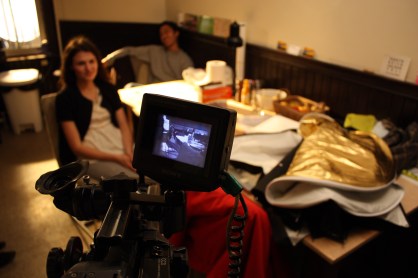
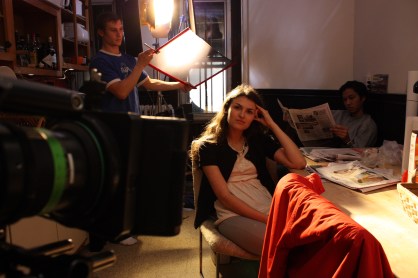
Stock and Lighting Tests

Posted in Films on March 11, 2010 by baker

February 3, 2010.  On location.

Photos calibrated for exposure using Kodak VISION3 7219 500T 16mm film stock.  Test footage came out beautifully.

Film: Roman Polanski: The Ghost Writer (2010)

Posted in Film Reviews with tags , , on March 6, 2010 by baker

The Pianist (2002) uniquely aside, Roman Polanski generally vacillates between twisted creepiness (Rosemary’s Baby, 1968) and pulpy silliness (Death and the Maiden, 1994) (or pulpy creepiness (Chinatown, 1974) and twisted silliness (The Tenant, 1976).  He’s got a strikingly clear visual sense, most of the time – his best work cuts with the organic intricacy of a brilliant previsualist – and an ability to strike a match against his performers without burning off their naturalism.  He’s a ludicrous actor himself, but like many actors – Clint Eastwood, Mel Gibson, Woody Allen – he knows how to direct others in ways that complement his own filmmaking energy; Jack Nicholson and Adrien Brody are as shockingly focused in Polanski’s films as is Richard Harris in Unforgiven (1992), or Jim Caviezel in The Passion of the Christ (2004).

There’s a fire inside him as well, speaking of vacillation, and Polanski’s films tend to be either full of thought or full of emotion, but rarely in equal measure.  And so he’s made The Ghost Writer, a well-written film in a structural sense, but a chaotic emotional jumble of painfully little consequence.  All the ideas are there, from the title on down: nobody is who they appear to be, and it’s usually less for intentionally deceptive reasons than from a sort of incidental lack of proclamation (there are exceptions).  I like this conceit.  It’s perfect for a filmmaker.  The ghost writer does a lot of work for a lot of money, polishing other people’s thoughts for which they – the other people – are ultimately responsible.  The ghost writer gets none of the credit, but also none of the fallout.  He drops in and out with complete anonymity.

Which, indeed, is how Ewan McGregor’s ghost writer operates in the modern island fortress of Pierce Brosnan’s former British prime minister.  Barely acknowledged upon his arrival, McGregor stands in the midst of Brosnan’s family and associates as a scandal erupts ferociously around them (but in the distance, overseas), neither a threat nor particularly useful, except as an occasional perfunctory PR wordsmith.  The film happens by and large in the immediate, in the constant discovery of new accusations and complications, both in the prime minister’s public and private life.  The circumstances are ripe for an exploration of the ghost writer’s soul, as one man privy to another man’s demons.  But Polanski doesn’t plumb for it, content to fill the screen with odd casting choices (Timothy Hutton and James Belushi in stock roles, Kim Cattrall weirdly cast as a British secretary) and a pervasive foul-weather gloom that smacks of vaudevillian excess rather than intelligent artistry.  Does it have to be?  Of course not.  Is it a missed opportunity for a capable director?  Definitely.

Polanski can direct above a potential haphazard script (Chinatown risks cornball hamhandedness at every turn), and I would say he’s probably giving The Ghost Writer his best shot, but he doesn’t seem to have inspired McGregor or Brosnan with much creative investment, and some of his other actors – Eli Wallach and Tom Wilkinson in particular – seem cast for lazily obvious reasons.  Pawel Edelman shot The Pianist with a graceful restraint he’s got no reason to emulate here; the film is dim and moody, but with some clever shots aside (like the last one, beautifully framed and choreographed), simply shows competent actors doing the mundane tasks Polanski and Robert Harris’ script asks them to do.  I’m of the (marginalized, I think) opinion that the mundane has a rightful, complex place in cinema, since we’re already made up of the mundane, the trivial, and the practically necessary, as functionaries in the modern world.  Escapism has its place, but we cast real shadows and reflections that we shouldn’t be afraid of examining in a smart film – one that knows how to let these little details coalesce into something much less ordinary than its parts.  The trouble is that Polanski and Harris seem to have confused movie mundane with real mundane.  A writer discovering secret letters and incriminating photographs in a plot that features the CIA and the Middle East is mundane in a Hollywood way; it’s so boring and contrived that it better be in service of not only some deeper thinking, but at this point in film history some self-conscious eye-winking.  It’s neither here.

To be fair, there is one other level at which Polanski might have intended The Ghost Writer to play, and that’s as weirdly clairvoyant autobiography.  It still wouldn’t quite work as a motion picture, but would at least take on a certain twisted, silly creepiness – the work of a director ostracized from society by his own crime, hidden away overseas and cranking out literal autobiographies couched in sweeping global scale.  That’s if he’s the prime minister.  If he’s the ghost writer, well hell, The Ghost Writer might as well be an allegory about its own making.  That both of these characters meet a similar end is just plain surreal in light of Polanski’s recent arrest – unless it’s possible to read this as Polanski’s own self-indictment.  A monumental stretch, sure, but I’m looking for more beneath this film.  It’s the only emotional current I can find.

Film: Scott Cooper: Crazy Heart (2009)

Posted in Film Reviews with tags , , , on January 28, 2010 by baker

Jeff Bridges, the screen presence, has always seemed on the cusp of either busting into a healthy gut laugh or dissolving in a fit of wrenched-soul despair.  The thin line he rides can make him at times immeasurably fun to behold – a poised, vaguely effete shaggy dog of a comedian – or incredibly hard to watch, his frail emotions roiling just behind his tiny eyes.  He’s got his tricks down, as any actor with a 30-year career behind him will, but in the best of roles he manages to troll beyond them for something fresh and clear, something uncannily human beyond the written lines and the essentially silly demands of narrative screen craft.  He’s as helplessly subject as anyone to the quirks of his director and editor, but at a certain level – like Philip Seymour Hoffman, Tommy Lee Jones, Pacino in his youth – he seems fundamentally unable to lie with his behavior and delivery, even if the material he’s working with doesn’t always offer truth on its own.

He’s one of very few actors – perhaps the only one – for whom I would see a film purely for a performance.  And most of his films are, as films, quite messy.  Peter Weir has his moments in Fearless (1993), particularly with the odd catharsis he delivers with the horrifying plane crash, but Bridges’ liquid presence, mired in willful oblivion and childlike sensual engagement, preserves the core of sublime human frailty that Raphael Iglesias’ script just about overlooks.  Terry Gilliam never quite knows where to put his camera, but Bridges roots his performance in The Fisher King (1991) in something ineffably real (and which, as played opposite Robin Williams, might not even be the right note for the film).  Even Joel and Ethan, floundering for a purpose in The Big Lebowski (1998) (sorry, everybody), can’t make Bridges anything less than utterly, absorbingly pleasurable to watch, a hippie lizard sunning himself in the funky eclipse of the Coens’ whimsy.

It should come as no surprise of any kind that Bridges’ Crazy Heart director, Scott Cooper, is an actor.  He pays an actor’s attention to molding his characters in mood-conscious time and space, and he’s done well to fill his crew with craftsmen weaned on actor-directed films: Billy Bob Thornton’s cinematographer, Barry Markowitz, and casting director Mary Vernieu; Ed Harris’ Appaloosa production designer Waldemar Kalinowski and construction coordinator Ben Zeller.  But Cooper also brings a lovely spatial awareness to Crazy Heart and a soft editing touch that spares his performers from having to carry too much weight for him; he frequently lets his camera drift into his scenes from the periphery, and cuts gently through them without visual impatience.  Bridges is free to play alcoholic, late-career country singer-songwriter Bad Blake as a man rather than as a narrative construct; Cooper does his job as director to build the film out of subtle, uncompromised blocks of articulate behavior.

The result is what Tender Mercies probably tried to be in 1983: a subdued character piece of remarkable progressive dimension, buoyed by a powerhouse of a central performance and superb supporting parts (Maggie Gyllenhaal and Colin Farrell do not disappoint).  But Robert Duvall (who’s executive producer of Crazy Heart, and plays a small part), an actor of great tact under the guidance of a Coppola or a Lumet, does not radiate the same unerring gravitas from one role to the next, and Mercies director Bruce Beresford is not a born filmmaker (nor is Cooper) or a gifted director of actors (Cooper is); there are layers to Duvall’s Mac Sledge that slip away from the film, unrealized, from lack of graceful craftsmanship.  It’s a tall order, to let performances carry a film.  The danger is that it’ll lose a sense of its own trajectory, lost in the muffling nooks and folds of character; a whole film may not emerge.  In the best case scenarios – The Godfathers, Last Tango, There Will Be Blood – enormously confident filmmakers allowed their films the possibility of being upended by overwhelming performances, all the while reigning them in under one cohesive cinematic net.  No scale of performance need ever expand beyond the boundaries of a film; no core performance need ever be scaled down to fit in a film, either.

Bridges has been around the block a few times, and I imagine he’s got a fine-tuned sense of his own presence.  His mannerisms sometimes show a bit more than they should in Crazy Heart – he has a way of extracting a cigarette from his mouth that seems plucked from some other, groovier, part – and it’s possible that Cooper wanted a little more Jeff Bridges in Bad Blake than the character necessarily required, but this is the kind of criticism one raises when one (me) doesn’t have anything more to criticize.  The music performances in Crazy Heart are frequent and lengthy, and illustrate the quality of old-time country music that, like classic rock, cracks open the showy foolishness of its modern pop descendants.  The songs Bridges performs – himself, rather well – are straightforward but reserved, sung inwardly with generous warmth that wends its way into the audience as on a light breeze – the audience in the film, and to us as well.  They are wonderfully understated songs, about being a man, about being an aging man; there’s a tricky little scene in which Gyllenhaal chastises Blake not for effortlessly picking out a gorgeous ditty on his guitar, on the fly, but for doing it on her bed, providing her with an association Blake the traveling performer will probably forget.  The song itself isn’t half the point.  Its position in time and place to the player and listener means a lot more, as song and memory leapfrog past each other.

There’s the sudden feeling, watching scenes like this, that Bridges the actor has earned his way to a role like this, with a lifetime of accumulated facets that add up to memories for us.  It isn’t the same as Mickey Rourke playing Randy Robinson in The Wrestler (2008), where Rourke’s own failures seemed as much a part of the performance as his acting.  Bridges was never self-destructive; he’s routinely the best part of his films.  And presumably, Bad Blake was once the best part of his own act: a brilliant songwriter, a magnificent performer, and a mentor to the younger country singer-songwriters who would skyrocket to fame far surpassing his own.  Bridges is not a marquee superstar, but he commands the kind of attention and respect reserved for the quiet lifers: the Tom Waitses, the Paul Schraders, the ones you can be sure have a vast reservoir of experience to draw from, and a lot more to say than they may care to spell out.

The film’s closing scenes remind us just how bound an actor is to forces outside himself.  The film as a dramatic vehicle ends a good twenty minutes before the credits roll, and we’re compelled to watch Blake rehabilitate.  Bridges does all he can with these scenes, and Cooper means them earnestly, and all things considered, Crazy Heart might very well be Bridges’ best film, but there’s a scene in a shopping mall security that takes Blake to the very end of the line.  A cut to a later, intimate concert – Blake calmer, quieter, an even older man – might have bypassed the de facto syrup ladled on instead.  The end isn’t a lie, really, but it’s not fair to provide such rousing redemption for a character so responsible for his own failings, and as conscious of his own need to change.  Bridges is above it.

Film: 3D in 4D

Posted in Film Reviews with tags , , on January 27, 2010 by baker

As fascinating as Avatar is – as a purely, purely audiovisual experience – my fear is that its success underscores the limitations of the 3D format.  The process, when it works, is unbelievably absorbing, destroying the two-dimensional barrier between real and screen life and blasting open a sense of how we operate in physical space.  Some of James Cameron’s best shots are in the live action sequences.  No more is a commander addressing his soldiers a simple question of imagery; in Cameron’s world, it’s an impasto of spatial orientation – the commander’s back, turned to us, a textured and implacable wall before his troops.  The effect is not lost in two-dimensional representation, but in 3D it functions less on our capacity to comprehend pictography – cartoons, essentially – and far more on our innate responses to depth and motion.  It makes a sequence involving a giant jungle critter attack stunningly visceral; our brains tell us this thing is about to bite us, and order us to recoil.  Suddenly we’re not watching a movie in order to react to its story elements, but to be held absolute captive by its sensual stimuli.

As an extraordinarily powerful Hollywood filmmaker, as well as an aficionado of science and kineticism, Cameron is uniquely able to allow this stuff to play out.  Other recent 3D films – Coraline and Up, say – have also used the process to amusing effect, but inevitably feel more allegiance to their stories than to 3D’s inherent dynamism; it winds up being a gimmick instead of a part of these films’ operating systems.  Anyway, to the extent that we are used to digesting motion pictures as animated stories, it’s entirely irrelevant (it’s almost easy to forget that it’s been around in movies since the ’50s, and that its popularity has surged and receded in more or less equal measure).  Cameron’s productive patience with HD technology has allowed 3D to flourish to a degree that it has never seen; Avatar contains more convincing, more immersive, 3D in its CGI sequences than Up did last spring, and it does it almost entirely without hurling objects through the screen at your face (something the preview for Tim Burton’s Alice in Wonderland couldn’t resist for all of three minutes).

And yet…and yet.  Dropping $237,000,000 doesn’t exactly inspire the sort of dramatic invention or piercing focus that allows a film like The Hurt Locker to work its way under your skin, or A Serious Man to embroil you in its tragicomic bravura.  And it’s not out of line to question whether the script or its preposterous scale came first in Cameron’s mind; he’s never shown much interest in crafting anything but efficient stereotypes for characters, human vehicles to enact his setpieces.  Somehow these have generally worked: Aliens (1986), The Abyss (1989), Terminator 2 (1991), True Lies (1994), and even Titanic (1997) are all masterfully paced action films of virtually no diluting complexity – nothing complicates his stunning virtuoso visual flow.  He’s the only filmmaker in history to consistently outspend and outreap.  He’s never had a flop, and not even Spielberg has been able to pull off such consistently expensive blockbusters – and at this point that has as much to do with the film’s own hype as with Cameron’s, the cinematic magician who can do no fiscal wrong.  But what he gains in visceral amusement he loses in everything else, and his films are airtight Pez dispensers of no greater ambition than the sugar contained therein.  Avatar is merely a Dances with Wolves ripoff with aliens and bigger guns.

Which leaves the advancement of 3D in question.  It’s still a vastly cumbersome process, full of technical pitfalls and optical shortcomings that limit certain frames and lighting effects (cinematographer Mauro Fiore discusses some of them at length in American Cinematographer, in case you were wondering why the live action scenes tended to look a little smoky).  To film with 3D takes time and money that most productions don’t have, and that most filmmakers won’t commit, and until the cost and ease of use both improve, it will be limited to the kinds of projects studios don’t want to take narrative chances with.  To make it more than a gimmick and less than an insult to a producer’s checkbook demands a specific breed of filmmaker, perhaps a new breed entirely: with Cameron’s patience and an artist’s sensitivity, and a businessman’s commercial acumen.

Step it up, Coens.  Bring Fincher.

Midnight, Windham.

Posted in Photography on December 31, 2009 by baker

Early AM in Maine, December 29, 2009.

Gah & Gram

Posted in Photography on December 26, 2009 by baker

Christmas, 2009.

The morning after

Posted in Photography on December 20, 2009 by baker

First snowfall, Brooklyn.  December 20, 2009.

4th Avenue views

Posted in Photography on December 19, 2009 by baker

Columbus Park 2

Posted in Photography on December 14, 2009 by baker

Mohammed, Afghani immigrant.  Saturday, December 12, 2009.